Mar 3, 2008

IRISH PLACES IN MONTREAL


St. Patrick’s Basilica
460 René-Lévesque Boulevard West
Montréal, Québec
H2Z 1A7
Tel : (514) 866-7379
Web site : http://www.stpatricksmtl.ca/

McLean’s Pub
1210 Peel Street
Tel :(514) 392-7770
Web site : www.bar-resto.com/mclean
English style pub with varied menu. Pool tables.

O'Hara's Pub
1197 University Street
Tel. : (514) 390-8881
Web site : www.bar-resto.com/murphys
Irish pub with bar menu, pool tables, karaoke.

McKibbins Irish Pub
1426 Bishop Street
Tel : (514) 288-1580
Web site : http://www.mckibbinsirishpub.com/
Montreal's Irish Pub with live entertainment, 18 imported beers on tap, Pub Grub and Irish sports on Satellite.

Ye Olde Orchard Pub & Grill
5563 Monkland
Tel. : (514) 484-1569
Web site : www.bar-resto.com/oldeorchard
Neighbourhood pub in Monkland Village with the flavour of the old country. Large terrace.

O’Regan’s Irish Pub
1224 Bishop Street
Tel. : (514) 866-8464
Web site : www.bar-resto.com/oregan
Celtic pub. Live entertainment, pub food, Irish & British beers.

Claddagh Pub
1433 Crescent Street
Tel. : (514) 287-9354
Web site : http://www.pubcladdagh.com/
Irish style pub on Montreal's famous Crescent St.

Hurley’s Irish Pub
1225 Crescent Street
Tel. : (514) 861-4111
Web site : http://www.hurleysirishpub.com/
Authentic Irish Pub in beautiful stone building. Many European beers & whiskeys, fireplaces, live Celtic music.

Le Vieux Dublin/Old Dublin
1219A University Street
Montréal, Qc
Tel: (514) 861-4448

Madhatter Pub
1220 Crescent Street
Tel. : (514) 987-9988
Web site : http://www.madhattersaloon.com/
The best dive in town!

A Salute to The Irish - from Nathalie de Grandmont

A salute to the Irish…


Hi, my name is Nathalie De Grandmont. Are you enjoying your stay in Montréal so far? We are at the corner of St-Urbain and René-Levesque and I want to start with a little trivia: Do you know what’s happening in this area on March 16th ? St-Patrick’s Parade, of course! Well, this is one of many things that the Montrealers owe to the Irish community. (In fact, according to the United Irish Societies, approximately 42% of the French in Québec might have Irish blood.) As a French Canadian myself, I might be one of them, who knows… That’s why today, I will tell you a bit why the Irish deserve to celebrate on that day: about the big role they played in our history and about the magnificent St-Patrick Basilica that was built for them - that you will see in a few minutes, on the left hand side of René-Lévesque boulevard – named after Saint-Patrick, the patron saint of the Irish.


The Parade:

But first, let’s get back to the Parade. Can you imagine 100 floats, music bands, and up to 600 000 people lined up along Ste-Catherine street, having fun with their kids and families ? Well, when the weather is good, this is what you can expect of our St-Patrick’s parade. We are very fortunate here in Montréal because our parade is not only popular but we also have one of the oldest St-Patrick’s Parade in North America and it is the longest continuous parade. It started in 1824 and, according to the historian of United Irish Societies of Montreal, it has been held every year since. Despite the wars, despite the Great Depression, and despite a big snow storm that hit the city once, just 2 days before the Parade. Despite all that , the Irish always managed to hold their parade: a little bit like a symbol of how nothing could stop them.

Their legacy:


As I said, The Irish deserve to celebrate because they brought here a lot more than just good music and good beer! In fact, they were our first big wave of immigration in Canada (after the French and the English), which started at the very beginning of the 19th century. A large number of the Irish immigrants arrived between 1845 and 1849, during the Great Famine. In 1845, a big disease completely destroyed the crop of potatoes in the fields of Ireland. And in the following years, thousands died of starvation or of typhoid fever. Thousands of Irish also chose to escape their country to come to United States or Canada (especially in 1847). The traveling conditions on the boat were terrible: many were already so weak by famine that they died during the trip. Even more sad: many others died, a few days after arriving on Grosse-Ile, which was the point of entry and the Quarantine station, a little upstream from Québec city. In the years before, many had died from cholera as well… But In 1847. dozens of them were dying every day: because of the typhus, a very contagious disease. To the extent that it became a huge epidemy and the authorities lost control. (To give you an idea: there are 6000 people buried in just one of the cemeteries of Grosse-Ile.)


The Irish who did survive the journey were not really attracted by agriculture and they established themselves in one of the oldest suburbs of Montreal: Griffintown. (Even tough they were Anglophones, the majority of them were catholics, and not active in business and politics, unlike the Scottish and the British, for example)
From 1821 to 1825, many of them were employed in the digging of the Lachine Canal: working 16 hours a day for low wages. (So, a few violent strikes occurred: in 1843, and later, when the canal was widened again, 30 years later) They also contributed to the construction of the railway and the Victoria Bridge. So, a lot of our city’s industrial growth came from the sweat and hard physical work of the Irish, as well as some of the French Canadians living in Pointe St. Charles, just beside. Griffintown remained the heart of the Irish community until the neighbourhood was partly demolished in the 1960s to build the Bonaventure Expressway.

St-Patrick Basilica.

Well, if the Irish were living in Griffintown (south-west of Montreal), why then is St-Patrick Basilica in the heart of downtown ? Well, it was not always like that. At the beginning of the 19th century, the St-Patrick parish included about 50 people… meeting in the tiny church of Bonsecours. (Their leader was Father Richards, who had been a Protestant priest in Virginia. He thought that he could come to the Montreal and convert all the Sulpician priests to his faith… but funny enough, it is the Sulpicians who converted him… )Then, they relocated to the abandoned church of The Recollets on Notre-Dame street… But again, it was not enough… because by 1840, the community had expanded to nearly 6,500. Can you imagine: every Sunday, hundreds of people, sometimes in the rain, were forced to kneel down in the cobbled streets, unable to squeeze inside…

After doing many sacrifices and giving a lot of their own money to build it, the Irish finally got their St-Patrick church… It was designed by a French Canadian architect. (P.L. Morin) in the gothic style of architecture popular in Europe in the 14th and 15th century. It is quite massive: 71 meters long, with a steeple rising 69 meters high. Today, it is considered one of Canada’s finest examples of gothic architecture, and the interior is probably even more beautiful. It is dominated by wood, and a lot of oak. And many of the wood panels contain carvings of shamrocks or fleur-de-lys (a tribute to the Sulpicians who were very involved). The nave is also decorated with many oil paintings of the Saints on both sides and most of all, great stained glass windows that were beautifully restored. (There has been several restorations and the most recent one was in the 1990’s.)

The church was inaugurated in 1847. Can you guess the date ? March 17th. That morning, the St-Patrick parade started at 7am from the Old Recollet Church off Notre Dame and proceeded on Notre Dame, St. James Street and then uphill on Commissioners street (McGill St.) to finish at St. Patrick's Church… where there was a big Mass, attended by 4000 people. Well, the first days and years of the church were very sad: the priests and nuns working there set up “Fever sheds” to take care of the sick, and then a facility for the orphans. Many of them died. And you can see their names on large panels close to the entrance. On the same wall, there is also a tribute to 2 other famous personalities, linked to the church: Thomas D’Arcy Mc Gee (an Irish man and one of the Fathers of the Confederation) and the poet Emile Nelligan, who was baptized in that church as well.

In 1989, again on March 17th, St-Patrick was elevated to the status of a minor basilica by the Vatican in Rome. Both the provincial and the federal government have classified it as a Historic Monument. The day I went there, the organ was playing when I walked in and I was very moved. I am telling you, you can really feel the many tears and sufferings that this Basilica has seen, but I think that over the years, it has also become a very important symbol of the accomplishment and legacy of the Irish.

So, if you want to pay tribute to the Irish, the Basilica is definitely a good place to start. I encourage you to go when you have a chance: it is open every day, and they also offer religious services on the week-ends. You can also come to the Parade .(This year, it will be on March 16th, and will start at noon, at the corner of Du Fort street ) But, since the Irish have also given us good music and many reasons to celebrate, please make sure to visit one of the typical Irish pubs… which are mostly located in the downtown area, along Crescent and Bishop streets, a little further west. I have here a little list of Irish pubs: where you can spend a very nice time and dedicate one toast – or two- to the Irish.


Well, thank you everyone… If you have any questions, I will be happy to answer them. I wish you all a very Happy St-Patrick’s day!

Feb 29, 2008

Happy spring break!

Don't forget the outing on March 10th and 11th.

For March 11th, don't forget to bring the following things:

1, Your copy of "Montreal is..."
2, Your index cards ( for your segment), or your empty cards :-)
3, Your document " organization of a tour"

Again, enjoy your break!
See you the week after.

PS:

Feb 19, 2008

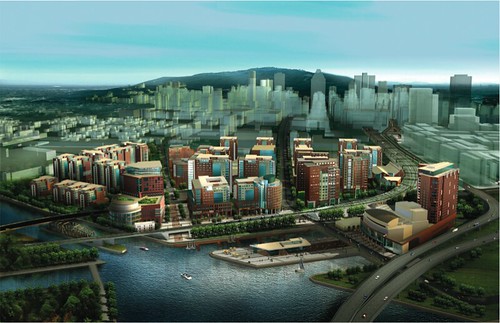
Huge Griffintown plan unveiled

Andy Riga, The GazettePublished: Thursday, November 22 2007

Don't be so negative and don't let this one slip by.

That was the message to Montrealers yesterday from Mayor Gerald Tremblay, who urged people to keep an open mind about a $1.3-billion residential-and-commercial project that aims to revitalize Griffintown, a run-down area at the foot of Peel St., between downtown and the Lachine Canal.


Described as one of the biggest private investments in Montreal history, the project, whose details were outlined yesterday, would include 3,830 residential units, retail outlets, a concert hall and a network of parks and public spaces.

Tremblay, who wholeheartedly supports the project, said he fears a backlash similar to the one that scuttled a $1.1-billion Loto-Quebec/Cirque du Soleil plan to build a casino and entertainment complex in the nearby Peel Basin last year.

"We must move beyond this type of inertia," Tremblay said of the negative reaction to the casino project.

"It is time we stop adopting such negative attitudes since it is only normal that in a major metropolis like Montreal that we should be able to at least explore projects that can have a positive impact on the social, cultural and economic development of our city."

Tremblay made the comments at a press conference at which he announced the city supports the project and that the South-West borough will hold public consultations on it in February. The city hopes to approve the project in April.


If that happens, the developer - Devimco, the company behind the DIX30 shopping centre in Brossard - says construction would begin in 2009, with completion within eight to 10 years.

At a separate press conference, Serge Goulet, co-president of Devimco, said the company has consulted for months with people who live, work and own businesses in the borough.

To deal with concerns it heard, it included more residential units (almost two-thirds of the floor space), added parks and public spaces (a total of 600,000 square feet), reduced the number of large stores included in the project (they would now make up less than a quarter of retail space) and moved parking underground (there would be 5,000 paid spots). It's also counting on the city's proposed tramway linking Griffintown to downtown and Old Montreal to alleviate traffic.

The project would feature several towers ranging from 10 to 24 storeys; the tallest building would be a hotel overlooking the Lachine Canal, which would have 32 floors.

To allay concerns of heritage activists, the developer said it will protect 12 structures (including the New City Gas and Crathern & Caverhil buildings) in the area, the former heart of the city's Irish community.

Two other buildings of historical value will be moved; another four will be demolished and partially rebuilt.


The area to be developed is currently home to 47 people, most of whom live in housing on Mountain St. that will not be affected by the project.

The developer wouldn't say how much of the land it already owns or has options to buy. But it said about 50 property owners own land in the area. Company co-president Jean-Francois Breton said enough deals with property owners are in place to leave the company confident that it will be able to buy all the land needed and won't have to ask the city to expropriate land.

Devimco and the city still have some convincing to do.

Pierre Morrissette, head of the Regroupement economique et social du Sud-Ouest, said his group's members - borough businesses, residents, community groups and unions - are reserving judgment until the public hearings.

They'll raise concerns about increased car traffic, how public transit will be integrated into the project and the amount of low-income housing included.

He said 800 people currently work in the area and the developer has given his group assurances it will ensure that many of the 4,330 permanent jobs to be created in the development will go to borough residents.

It's unclear how the area's heritage will be preserved, said Heritage Montreal's Dinu Bumbaru. Saving buildings isn't enough, he said. "There's the street pattern, the scale on the street, the character of the buildings, the views - of the Lachine Canal and the Five Roses sign, for example," he said.

Bumbaru wondered why the borough will hold the public consultation, rather than the city's independent Office de consultation publique. "This sounds like it's going to be a little kitchen meeting over a billion-dollar project," he said.

Downtown merchants, for their part, fear the project will pull people away from businesses on and around Ste. Catherine St., said Andre Poulin, executive director of Destination Centre-Ville, which represents downtown retailers.

"Instead of coming to Ste. Catherine St., people will go there - a brand new development," he said. "People working downtown will jump on the tramway and in a couple of minutes be there for lunch."

The city says it doesn't expect the Griffintown project will affect downtown. Tremblay pointed to a report the city commissioned from HEC Montreal marketing professor Jacques Nantel. He was asked to review a study the developer commissioned of the project's impact.

Nantel concluded Griffintown will probably not affect downtown businesses. He noted stores there are losing customers to suburban malls, with remaining downtown customers taking public transit and shopping on foot. Griffintown retailer would cater to different shoppers - those in cars.


This is the link of the group Save GrifinTown
This is the link of more pictures

very nice job

Hi, Hugo:
I don't know it is right place that I can put some word here?
thanks a lot for your nice job
maggie

Feb 18, 2008

A Handbook For Montreal's Heritage


Table of Contents


Preface
I. Historical Milestones
II. What is Heritage?
III. Montreal’s Heritage
IV. Conservation in Montreal
V. The Tools of Heritage Conservation
VI. Getting a Sense of Strategy
Suggested Readings


Appendix 1 Excerpts from the Cultural Property Act
Appendix 2 Letter-writing Guide


Useful Heritage Addresses
Organizations, Institutions and Municipalities


Research: Claudine Déom


Editing: Claudine Déom and Dinu Bumbaru


Drawings: Dinu Bumbaru


Acknowledgments: Nancy Dunton, Kate Swoger and Glenna Uline


Héritage Montréal gratefully acknowledges the support of
The J.W. McConnell Family Foundation.